What to Look for in a Shared Platform with MDT Coordination and Patient Pathways
As NHS Trusts and ICSs pursue smarter, more interoperable ways to coordinate care, one thing is clear: tools that isolate MDT meeting planning from pathway tracking are no longer enough. To drive real clinical efficiency, organisations need platforms that combine structured multidisciplinary team (MDT) coordination with pathway-driven, patient-centric workflows.
This article breaks down the core capabilities every such platform should offer, then compares five real-world tools used across NHS and health systems today.
Core Features Every Combined MDT & Pathway Tool Must Offer

Shared MDT Scheduling & Templates
A modern system must allow users to create and reuse meeting templates, configuring layout, specialty context, agenda types, and visual styles. Support is needed for scheduling future MDTs, both ad-hoc and recurrent. Assigning patients (individually or in bulk) across hospitals and pathways must be straightforward, with visibility into upcoming meetings filtered by site or specialty. Reassignment should be fast, auditable, and require minimal clicks.
MDT Meeting Workflow
The in-meeting experience matters. A comprehensive interface should present session metadata, date, time, type, and invited participants, alongside a structured book of patient cases. These must allow decisions to be recorded, actions to be triggered, and notes to be retained. Embedded messaging (real-time or async) is key, with markdown formatting, message locking, and strike-throughs for safe collaboration. Clinicians need attachment support for documents and images and a reliable audit trail of changes, conversations, and access.


Patient Pathway Management
Pathway logic shouldn’t be hardcoded. A configurable engine should let admins define, import, or map pathway templates grouped by specialty. Systems must detect matching pathways during import and allow remapping, renaming, or expansion. Form associations are essential, forms should link to pathway stages and trigger workflows based on submissions or MDT outcomes. Patient assignment (manual or automated) must support batch operations and be manageable by admins or clinicians.
Form Management
Dynamic form creation is at the heart of patient data collection. Tools must support a drag-and-drop interface with multi-page structure, conditional logic, reusable sections, and validation rules. Admins should manage taxonomy (tags, folders), version control, and comment systems, allowing form feedback, tagging, and file attachment. These forms should link naturally into MDT agendas and pathway stages.


Workflow Automation
Key transitions, decisions to treat, referrals, alerts, must be linked to task generation. Task tracking, notifications for due dates or completions, and escalation paths should be configurable. Workflows must reflect clinical reality but remain auditable and adaptable.
Dynamic Reports and Management Information
Modern care systems need more than just data, they need to make that data meaningful. A coordination platform should provide reports that are easily created and read, visual dashboards, and tailored insights that help managers track progress and identify gaps across teams and services. Integrated reporting systems need to be easily adapted so that they can fit within existing reporting environments.


Notification, Messaging and Discussion
To support real coordination, messaging tools must do more than just send alerts. A good platform should help teams stay informed, share updates, and discuss decisions, whether in real time or asynchronously. Notifications should be clear, timely, and relevant, while discussion threads should be easy to follow and linked to the right patient, meeting, or task, in order to reduce delays and not create noise.
Security, Integration & Compliance
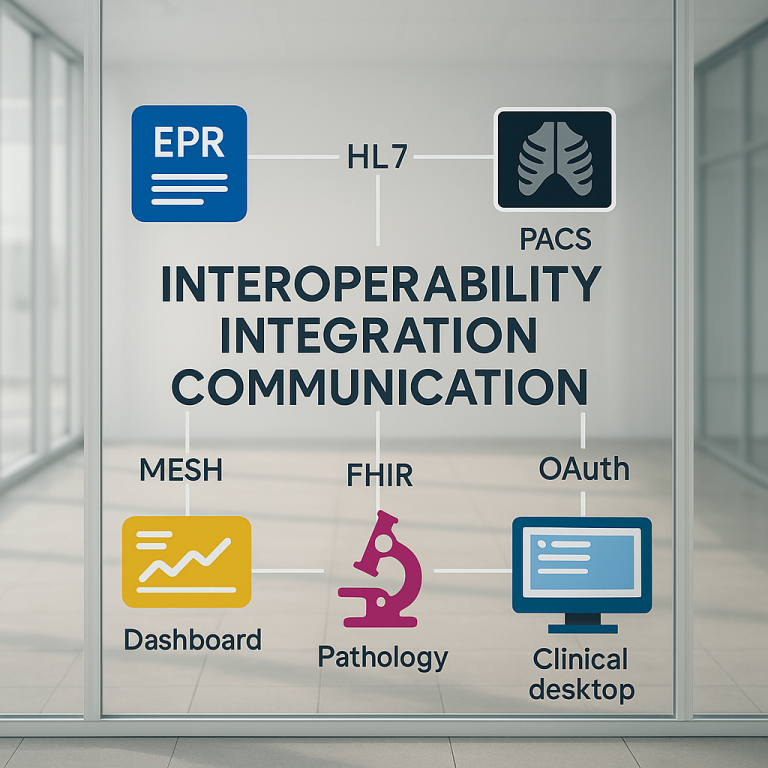
No tool is useful in isolation. HL7 and FHIR-based message triggers must be supported, as should bidirectional integration with EPRs, PAS, and national services like NHS Spine. Calendar sync, role-based access via NHS Login, OIDC/OAuth2, and SSO via Keycloak or Azure AD are all now expected. Finally, a fully traceable audit log across meetings, chat, forms, and data access is essential for governance.

Tools in Scope
- Ardeo: A dedicated coordination engine combining MDT meetings, pathway logic, and dynamic forms with full-stack integrations and audit logging.
- Cerner Millennium: A major EPR with native care pathways and MDT capabilities, often deeply embedded in Trust infrastructure.
- Meddbase: A web-based clinical system used in both NHS and private settings, with moderate support for care planning and team-based work.
- Epic Care Pathways + MDT Module: A mature EPR offering a tightly integrated set of tools for pathway progression and meeting documentation.
- OpenEyes: An ophthalmology-focused platform that includes decision-making workflows, now expanding with pathway-like tooling.
Feature-by-Feature Comparison Matrix
| Feature | Ardeo | Cerner Millennium | Meddbase | Epic Care Pathways | OpenEyes |
|---|---|---|---|---|---|
| MDT meeting template creation | ✔️ | ◑ Admin-defined | ✖️ | ✔️ | ✔️ (Ophthalmology) |
| Ad-hoc & recurrent scheduling | ✔️ | ✔️ | ◑ Limited | ✔️ | ◑ Manual |
| Assign patients (individual, batch) | ✔️ | ✔️ | ◑ CSV only | ✔️ | ◑ Limited |
| Patient-linked agenda & MDT book | ✔️ | ◑ Embedded in notes | ◑ Summary view | ✔️ | ◑ Decision notes |
| Meeting chat (lock, formatting) | ✔️ | ✖️ | ◑ Comments only | ✔️ | ✖️ |
| Attachments & audit trail per meeting | ✔️ | ◑ Notes-only | ◑ Basic | ✔️ | ◑ In logs only |
| Dynamic form engine, versioned | ✔️ | ◑ Static templates | ◑ Basic | ✔️ | ◑ Limited |
| Conditional logic in forms | ✔️ | ◑ Limited rules | ✖️ | ◑ Limited | ◑ Minimal |
| Pathway template import & mapping | ✔️ | ✔️ | ◑ Developer-led | ✔️ | ◑ Manual setup |
| Workflow automation / task triggers | ✔️ | ✔️ | ◑ Manual | ✔️ | ✖️ |
| HL7 / FHIR & EPR integration | ✔️ | ✔️ | ◑ Custom setups | ✔️ | ◑ Limited |
| SSO (Keycloak, OIDC, NHS Login) | ✔️ | ✔️ | ◑ Azure AD only | ✔️ | ◑ Via host system |
| Audit logging & compliance-ready | ✔️ | ◑ EPR logs | ◑ Partial | ✔️ | ◑ Limited |
| Deployment flexibility (cloud/on-prem) | ✔️ | ✖️ EPR-only | ✔️ Cloud-native | ✖️ | ◑ On-prem only |
Comparative Analysis
Ardeo provides the most complete out-of-the-box experience for teams needing flexible MDT scheduling, real-time collaboration, dynamic pathway logic, and robust integration. It’s designed as a modular companion to existing EPRs and national services, rather than a replacement.
Cerner Millennium supports many of these features in principle but lacks the configuration and workflow flexibility that clinical users often need. Its strength is deep EPR integration, not agility.
Meddbase has pathway and tasking capability but lacks structured MDT logic or dynamic forms. Best suited for simpler use cases or commercial clinics with looser governance.
Epic Care Pathways and MDT modules are mature and well integrated. However, they require full Epic deployment, and configuration is non-trivial. It’s powerful but often not accessible outside large teaching hospitals or major Trust-wide implementations.
OpenEyes delivers excellent, domain-specific workflows in ophthalmology. While there’s potential for broader use, it lacks the generalised tools needed to support MDTs across multiple specialities.
Recommendations for Organisations
- Looking for modular, standards-compliant, pathway-enabled MDT tooling? Ardeo provides depth, integration, and clinical usability.
- Already on Epic or Cerner and have strong informatics support? Their native tools can be powerful, but expect longer lead times and less flexibility.
- Working in a niche or outpatient-heavy context? OpenEyes or Meddbase may offer focused solutions; but be ready to supplement with manual coordination processes.
Conclusion
The future of multidisciplinary care demands more than just scheduling. It needs tools that integrate conversations, decisions, pathways, and documentation into a single, governed system.
When comparing platforms, organisations should weigh flexibility, integration depth, governance needs, and how much development support is available in-house. Tools like Ardeo show what’s possible when MDT and pathway workflows are treated as first-class citizens; not afterthoughts.